
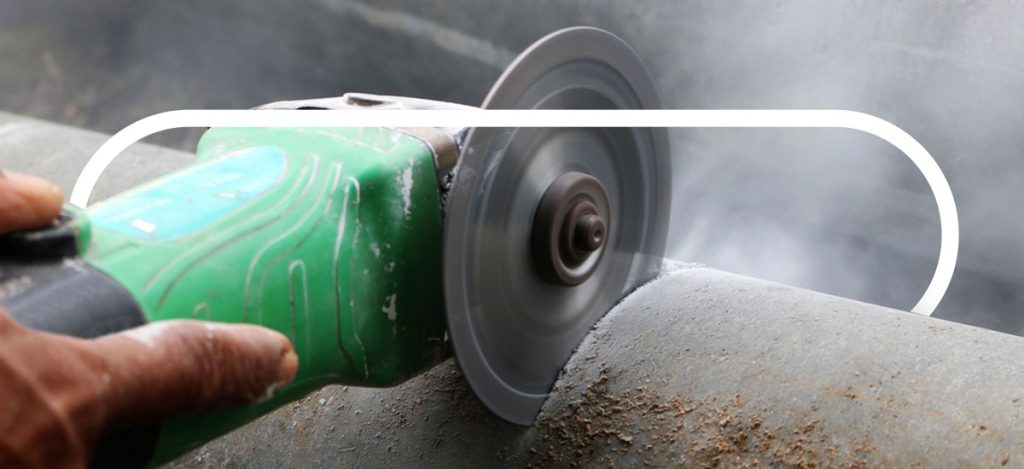
Understanding how blade selection impacts cutting speed and quality is essential for manufacturers facing costly production inefficiencies and quality issues. Regardless of the material you’re working with, overall geometry affects cutting blade efficiency.
Four critical geometric factors — cutting edge angle, tooth shape and pitch, blade material and blade width — influence blade performance. Proper slitting blade geometry reduces downtime, extends blade life, improves precision and lowers operational costs. Learn more about the impact of blade geometry on cutting efficiency below.
Cutting Edge Angles
The cutting edge, or bevel, angle is one of the most important determinants of performance. Sharp, low-angle edges can be susceptible to chipping. These work well for films, foils and thin textiles where clean cuts matter. High-angle edges are more durable and ideal for tougher materials like rubber, plastics and steel, though they need more cutting force.
This trade-off between sharpness and durability demonstrates why choosing the right blade geometry for your specific application is critical.
Edge geometry functions as a wedge, with the angle affecting how easily it cuts through material. Sharper angles are better for slicing soft materials, but tend to be more fragile. Wider angles typically withstand repeated mechanical stress better. Operations that optimize bevel geometry often see significant reductions in material waste and scrap rates.
Tooth Shape and Pitch
To control cutting, serrated blades feature specialized tooth designs, height and pitch. The spacing and shape of teeth directly affect speed, material removal and edge quality. The following are important aspects of tooth geometry:
- Tooth pitch: The spacing between tooth tips. Fine pitch produces minimal tearing, while medium pitch offers balanced control and speed. Heat dissipation often improves with a coarse pitch.
- Tooth profile: There are different shapes for different applications, such as triangular for general purpose, scalloped for food, hook for rubber and wave for textiles.
- Gullet: These recessed areas between teeth create space for materials while cutting. Deeper and wider types allow for better debris clearing and help prevent buildup.
Blade selection impacts cutting speed in demanding applications. For example, serrated blades with fine teeth reduce surface tearing in foam and soft materials. Similarly, a coarse blade with a hook-tooth design cuts thick rubber strips faster and lasts longer than standard blades in recycling facilities.
Aligning the profile and pitch to your machine’s revolutions per minute (RPM) and material density helps optimize performance in converting. Choose a design with fine, stable teeth for high-speed operations, or one with coarser teeth for heavy-load, low-speed cutting.
Blade Material
The blade’s material helps determine under-stress performance and the most practical geometry. This choice affects hardness, wear resistance, heat tolerance and compatibility with different applications.
Compare different materials in slitting blade geometry:
- Stainless steel: This material offers excellent corrosion resistance, ideal for food, medical and light-duty applications. Stainless steel also supports medium bevels and maintains performance in humid environments.
- High-speed steel: High-speed steel retains integrity at elevated temperatures and is compatible with thin and thick edges. These traits make it perfect for friction-intensive substrates, including paper, wood and plastics.
- Tungsten carbide: This material features exceptional wear resistance. It’s best for thick, tough edges in materials like metal, rubber and composites.
- Tool steel: Tool steel offers good wear resistance and toughness. It’s common in score-cut blades, with popular alloys including 52100 and D2.
Your substrate and application determine the blade material. For instance, stainless steel blades resist adhesive buildup, so they’re ideal for coated materials. Operations with chemical exposure or hygiene requirements benefit from corrosion-resistant options. Harder materials like carbide and HSS are necessary for abrasive substrates or high-volume operations.
Additionally, material choice affects which edge geometries are achievable. Misalignment between material and geometry causes premature failure. Ultrathin geometries made from brittle materials can lead to tip breakage after only hundreds of cuts.
Blade Width
Blade thickness affects rigidity, resistance to flex and energy efficiency. Performance characteristics reveal clear trade-offs. Thinner blades achieve higher cutting speeds with lower material waste but may require more frequent adjustments. Midrange blades balance speed and stability for general applications. Thicker blades operate with greater stability and minimal deflection, though they generate more material waste due to wider kerfs.
Thinner blades deliver sharper, cleaner cuts but are susceptible to heat-related wear. This can cause blade deflection or thermal deformation, potentially affecting precision over extended production runs.
The recommended thickness differs by application:
- Thin blades: These are ideal for films, foils and labels. They provide precision cuts with minimal kerf, but require stable machine feed to prevent deflection.
- Midrange blades: These blades offer a good balance between precision and durability. They’re best for paper, textiles and lightweight nonwovens.
- Thick blades: Suited for recycling, plastics, rubber and heavy materials, thick blades are equal to or greater than 1mm. Their sturdiness resists bending under pressure and helps support straight cuts.
Blade Geometry Effects Across Different Materials
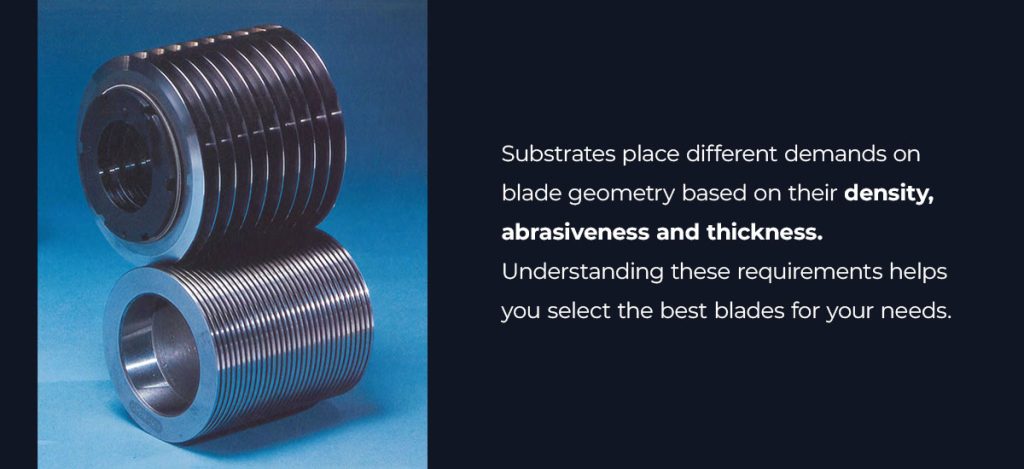
Substrates place different demands on blade geometry based on their density, abrasiveness and thickness. Understanding these requirements helps you select the best blades for your needs.
Cutting Foil and Metal Materials
Proper blade selection for metal cutting applications reduces edge feathering and maintains dimensional accuracy across production runs:
- Foil and metal materials require rigid blades with steep bevel angles to achieve optimal cuts
- Carbide or HSS materials with heat-resistant coatings prevent thermal degradation, while spine-reinforced designs prevent flexing under load.
- Double-hollow-ground blades are preferred for soft foils to prevent edge rolling or tearing.
Slitting Nonwoven and Textile Materials
Choosing the right cutting method for textile applications ensures clean, fray-free cuts. The geometry must accommodate the material’s flexibility while maintaining edge integrity throughout production runs:
- Nonwoven and textile materials benefit from wave-edge or scalloped designs with high-sharpness bevels
- Ultrapolished finishes reduce drag and prevent fiber pull-out
- Micro-serrated blades can minimize edge tearing and fiber shedding
Processing Paper and Tag Materials
The right blade geometry for paper and tag materials significantly impacts edge quality and production efficiency:
- Microserrated blades produce clean edges and reduce dust generation
- Flat-top circular knives are popular for their edge profile and angle of attack, which supports high-volume slitting
- Too much force causes jagged edges or material stretching, while optimal geometry improves throughput with clean cuts and less energy consumption
- Shear slitting methods using paired circular knives deliver superior edge quality at high speeds
Converting Plastic and Rubber
Plastic and rubber converting requires different approaches based on material hardness and flexibility:
- Reinforced thick blades handle rubber effectively, while hook-tooth serrated geometry excels at tearing heavy materials
- Low-friction coatings, such as titanium nitride, prevent sticking to plastic films
- Thin-profile blades are suitable for laminated films in packaging applications
Label Cutting Applications
The narrow width requirements and high-speed nature of label cutting make blade geometry optimization critical for maintaining production efficiency:
- Tight tolerances in blade geometry ensure consistent cut quality and reduce material waste
- Ultraclean edges prevent sealing failures
- Precision-ground bevels support dimensional accuracy in high-speed operations

Enhance Cutting Efficiency With Our Innovative Solutions
Blade geometry is crucial to operational efficiency and quality, and the ideal geometry can reduce downtime, extend blade life and deliver cleaner cuts overall. Intertech Precision boasts over 70 years of experience in precision slitting and converting solutions. Our expertise in improving cutting efficiency extends to customizing blade geometry, steel grade and heat treatment to match your materials and speeds. We also offer knife sharpening, honing and additional services for peak operational performance.
Request a quote to discover how our innovative products boost efficiency, or connect with us online for expert buying advice.